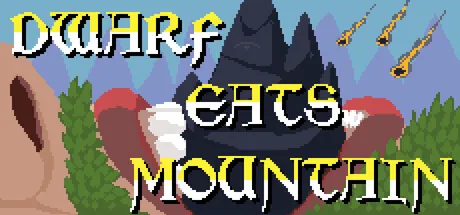
Dwarf Eats Mountain
A dwarven mining incremental that turns every run into a demolition problem — hire dwarves, point war machines at a mountain, and work out how to get the gold home before the mountain takes it back.
8.5 / 10
Games that play in your browser — phone or desktop.
Browse by platform
71 games we have reviewed that run on Browser, best first.
71 reviews
A dwarven mining incremental that turns every run into a demolition problem — hire dwarves, point war machines at a mountain, and work out how to get the gold home before the mountain takes it back.
8.5 / 10
A Uruguayan studio's first major project turned a portal sponsorship deal into the Flash browser era's most influential tower defense game — one that outlived the plugin it was built in by porting itself, tower by tower, onto seven other platforms while the original still runs today under emulation.
8 / 10
A ninja falls, slides and wall-jumps through a wireframe apartment building full of homicidal robots, in the 2004 freeware download that taught a generation of Flash developers what momentum-based platforming could feel like — years before N+ or N++ existed.
8 / 10
Edmund McMillen and Florian Himsl's 2011 Flash roguelike sold itself for $4.99 on Steam rather than living free on a portal, and turned a three-month game jam project into the game most credited with dragging the roguelike out of niche obscurity — years before Flash's own limitations forced McMillen to rebuild it from scratch as Rebirth.
8 / 10
A one-button endless runner built in five days for a "Bare Minimum" game jam in August 2009, given away free with no portal exclusivity, and now sitting in MoMA's permanent design collection as the game that invented the endless-runner genre — while remaining, on its own terms, about ten minutes of content that never asks anything new of you after the first run.
7.5 / 10
A 2010 Flash tower defense that flips the genre's morality — you play the overlord, and the "heroes" are the wave of invaders trying to steal five gems out of your cave. A NotDoppler sponsorship deal turned it into, by the developer's own account, Kongregate's number-one-rated game for the better part of a year; a real skill-point system and a genuine difficulty wall around level 14 are why that reputation is only partly still deserved today.
7.5 / 10
Paul Preece's one-man, ad-funded Flash game let players build the maze the enemies walked through instead of just shooting at a fixed road, and the idea spread to 15.7 million plays within four months of its March 2007 launch. Eighteen years on, the core puzzle still works; the presentation, the solo content, and the multiplayer spin-off that ran for over a decade have not all aged the same way.
7.5 / 10
A free 2010 turn-based JRPG parody that gave its three-hero cast a walkable overworld for the first time in the series, wrapped a genuinely deep elemental-combat system in deliberately juvenile humour, and is still free to play today on Steam and itch.io.
7.5 / 10
A six-day art-game experiment about quitting your job, one act of quiet refusal at a time — five minutes long, endlessly written about since, and still one of the cleanest arguments Flash ever produced for treating games as a critical medium rather than a toy.
7.5 / 10
A two-person Hungarian studio's June 2008 Armor Games debut asked a simple question of the maze tower-defense format Desktop Tower Defense had just popularised — what if the upgrade path wasn't the tower, but a gem you could pull out, combine, and throw as a grenade — and built a persistent wizard-levelling meta-game around the answer that outlived Flash itself.
7.5 / 10
A ragdoll physics playground where the violence is the punchline — Jim Bonacci's free browser game turned decapitation into slapstick, built its longevity on a level editor that outgrew the base game by orders of magnitude, and outlived Flash itself through a 2020 rewrite most of its contemporaries never got.
7.5 / 10
A ten-minute Flash platformer from 2010 that opens by telling you your gender is wrong, then spends the rest of its length making you choose between a narrator's approval and your own defiance — and rigs the controls so that choice never feels comfortable either way.
7.5 / 10
A solo developer's take on RuneScape-style skilling, rebuilt as a multiplayer idle game with a real player-driven economy — and a cow theme it commits to with a straight face.
7.5 / 10
Bennett Foddy's 2008 ragdoll sprinting game reduces a 100-metre dash to four keys mapped directly onto muscle groups, and the resulting near-impossibility is the entire point — a joke about video game control schemes that outlived the punchline to become a genuine design influence.
7.5 / 10
A two-person game-jam prototype turned into the browser's most influential permadeath MMO — a bullet-hell shooter where death erases your character entirely, funded on cosmetics alone at launch, and still running fifteen years later as a live game that quietly isn't a Flash game anymore.
7.5 / 10
A free 2009 Newgrounds puzzle platformer where you solve rooms by recording and replaying your own past movements, wrapped around a hermit's confession that turns the clone mechanic into the point of the story rather than a gimmick bolted onto it.
7.5 / 10
A three-level, stick-figure platformer that Brad Borne built alone in Flash and put up on Newgrounds on 14 March 2006 — and the one Flash game whose momentum-and-wall-jump movement was good enough to get itself remade twice, once by EA on consoles and once by its own creator on Steam, nearly two decades later.
7.5 / 10
John Cooney's 2009 one-room platformer spends thirty stages breaking its own single layout — reversing the controls, killing the lights, handing movement to the mouse — and it is still turning up on "best Flash games" lists in 2026 for exactly that trick, even though the trick itself only works once.
7.5 / 10
A three-week Flash prototype about mice, cheese and a randomly chosen "shaman" who builds the level around them went viral through 4chan and SomethingAwful in 2010 and never actually died — Atelier 801 kept it alive as its own live service for sixteen years while almost everything else in this archive stopped running.
7.5 / 10
A four-day joke about achievement bloat, built by Armor Games' first employee, that turned "do 100 arbitrary things to a blue elephant in one room" into a bigger hit than anything with actual level design that Armor Games shipped that month — and that got a real Steam re-release with real achievements fifteen years later, which is funnier than anything in the original script.
7 / 10
A one-man Flash arena brawler about hitting blobs with an oversized sword, saved from disposability by a 110-medal award system that turns every fight into a checklist worth chasing — and still running today, cleanly, in Ruffle.
7 / 10
A 2006 archery-and-castle-defense hybrid built by one small team to advertise its own sequel — thirty levels of click-and-drag ballistics and troop economy that still turns up millions of plays on the portals that hosted it, wearing a name that gets it mixed up with a completely different game every single day.
7 / 10
A luchador launches himself out of Candy Land, bounces off gummy bears for distance, and spends the loot on permanent upgrades — Juicy Beast's February 2011 debut launcher, still readable today as the rough draft for the much bigger Burrito Bison Revenge a year later.
7 / 10
A Newgrounds exploration game a teenage Thomas Brush built alone in ActionScript 2.0, drawing over 8 million plays in 2010 on hand-drawn atmosphere and dream logic that its own fifteen minutes of gameplay can't fully carry.
7 / 10