Touch: four pads along the bottom: the two outer pads are STEP L and STEP R (swing that hip), the two inner pads are REACH L and REACH R (lift that knee over an obstacle). Alternate STEP L / STEP R in a steady rhythm to walk and tap REACH to clear kerbs and gaps. Pause is top left, mute top right, and the rhythm-guide toggle sits just under mute. · Keyboard: F and J step the left and right hips (or the Left and Right arrows); D and K reach the left and right knees (or Down and Up). Enter or Space starts and retries, N takes the next course, P or Esc pauses, M mutes and G toggles the rhythm guide.
About:
A coordinated-limb balance game in the spirit of the 2000s Flash classics, made in-house for Leetdom. You are winding up a little brass toy courier and sending it down a short garden path with a parcel to deliver. There is no autopilot: forward motion only happens when you fire the courier's joints yourself. STEP L and STEP R swing the left and right hips; REACH on either side pulls that knee up so the foot clears a kerb, a step or a gap. Find the alternating rhythm and the courier strides; rush it or fire the same leg twice and it teeters, pitches forward and winds down onto its face.
The heart of it is the clockwork “wind”. Every time the courier topples for too long it spends one wind from its mainspring and springs back up at the last checkpoint it passed. Run out of winds and the spring runs down — that run is over. Crucially the difficulty is never a trick of the controls: the inputs always do exactly what they say. What changes between modes is how forgiving the courier's own balance is and how many winds you carry. Practice gives a strongly self-righting courier and endless winds, so a first-timer can cross the Garden Gate and feel the gait; Standard tightens the balance and gives five winds; Expert removes the balancing help entirely and gives three, which is the true coordination challenge the family is known for — funny to fail, satisfying to master. A ghost of your best time and a three-star rating per course give you something to chase, and an on-screen rhythm guide can be toggled off once the stride is in your hands.
There are three courses that teach, then test: Garden Gate (flat, with a couple of gentle humps to learn the step), Cobble Climb (a real ascent with a stepped kerb that demands well-timed REACHes) and The Long Lane (rolling ground and a dip that punishes a sloppy cadence). The whole simulation is a deterministic fixed-step physics model — the same inputs always produce the same walk — so your runs are honest and repeatable. Every piece of art is drawn in code and every sound is synthesised in code; there are no image or audio files, no network and no tracking, and your best times are saved on your device.
Credits:
Made by Leetdom, 2026. Written for Leetdom, and it lives here.
Phone check: 2026-10-03: real CDP touch on the phone profile (390x844 portrait): from the title, PLAY starts Garden Gate in Practice and alternating taps on the STEP L / STEP R pads walked the courier to the finish — “Delivered! 02.63s”, three stars, “New best time!” — and the one-tap “Run it again” re-entered a fresh run. A touch loss run on Expert/Garden (overstriding — firing STEP and REACH together on the same side, alternating sides) overreached and toppled through all three winds to the “Spring ran down” screen showing how far you got, and its one-tap “Try again” restarted with winds restored. Landscape 844x390 touch and desktop 1280x800 keyboard both render the menu, play, win and pause correctly; on desktop F/J walked to the finish, Enter re-ran it and Esc paused and resumed. A headless pass confirmed the game still boots to the title with localStorage blocked, that the canvas backing store tracks the viewport across 844x390, 1280x800 and 360x640 with no errors, and that it makes zero outside network requests (only its own five local files) with no console or page errors. Audio was measured in an OfflineAudioContext: a full busy mix peaks at -8.9 dBFS (no clipping), high-frequency energy sits about 62 dB below the low band (nothing harsh), the music bed runs about 15 dB under the SFX, and there is true digital silence (below -200 dBFS) between sounds. A deterministic sim/solver test suite passes: two identical input runs produce identical traces, no NaN or blow-ups across all modes, the hands-off courier does not drift, and a scripted walker completes every course in Practice and Standard within the wind budget, and no single-leg input — mashing one hip at any period, hip+reach, or simply holding one hip down — can clear or star Expert: a foot the player never lifts is staked to the ground, so single-leg play stalls part-way instead of dragging the idle foot to the finish, and a naive fixed-cadence alternation cannot cheese Expert either. Honest alternation remains the fastest and only winning Expert strategy; Practice and Standard are unaffected.
Rate this game:
One vote per game each month.
Play next:
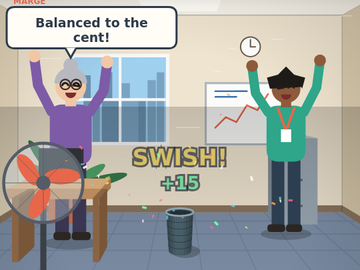
Bin ShotFlick a scrunched-up memo across the room and into the bin, while a desk fan tries its best to blow it somewhere else. Six places to throw from, from an open-plan office to a windy rooftop at dusk.
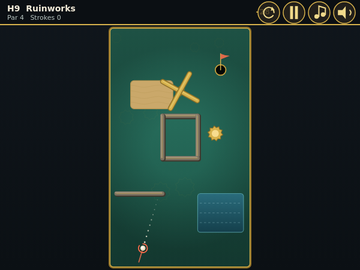
Clockwork GolfPocket mini-golf through wound-down clockwork ruins. Drag back, read the lie, and bank your ball past turning gears and sliding gates. Nine hand-built holes, par 28.
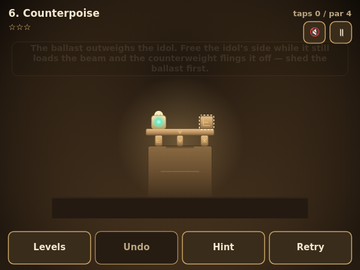
CradlestoneA carved idol is held aloft by a tower of runed stones. Dissolve them in the right order and the idol settles gently onto its cradle; pull the wrong one and it topples, drops too hard and shatters, or slides off into the dark.
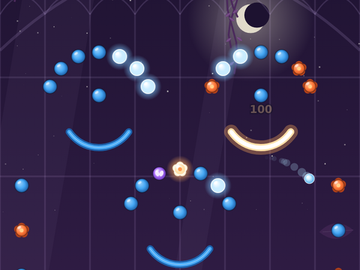
Drip DropAim a brass watering spout, let a single dewdrop fall through a night greenhouse of glass buds, and open every orange bloom before your ten drops run out. Five gardeners, 34 boards, 16 challenges.